# Mine the gap
Even if I’m not fully into Cybersec anymore I still enjoy testing my skills with CTFs from time to time ( especially along the wonderful Hackappatoi team ) !
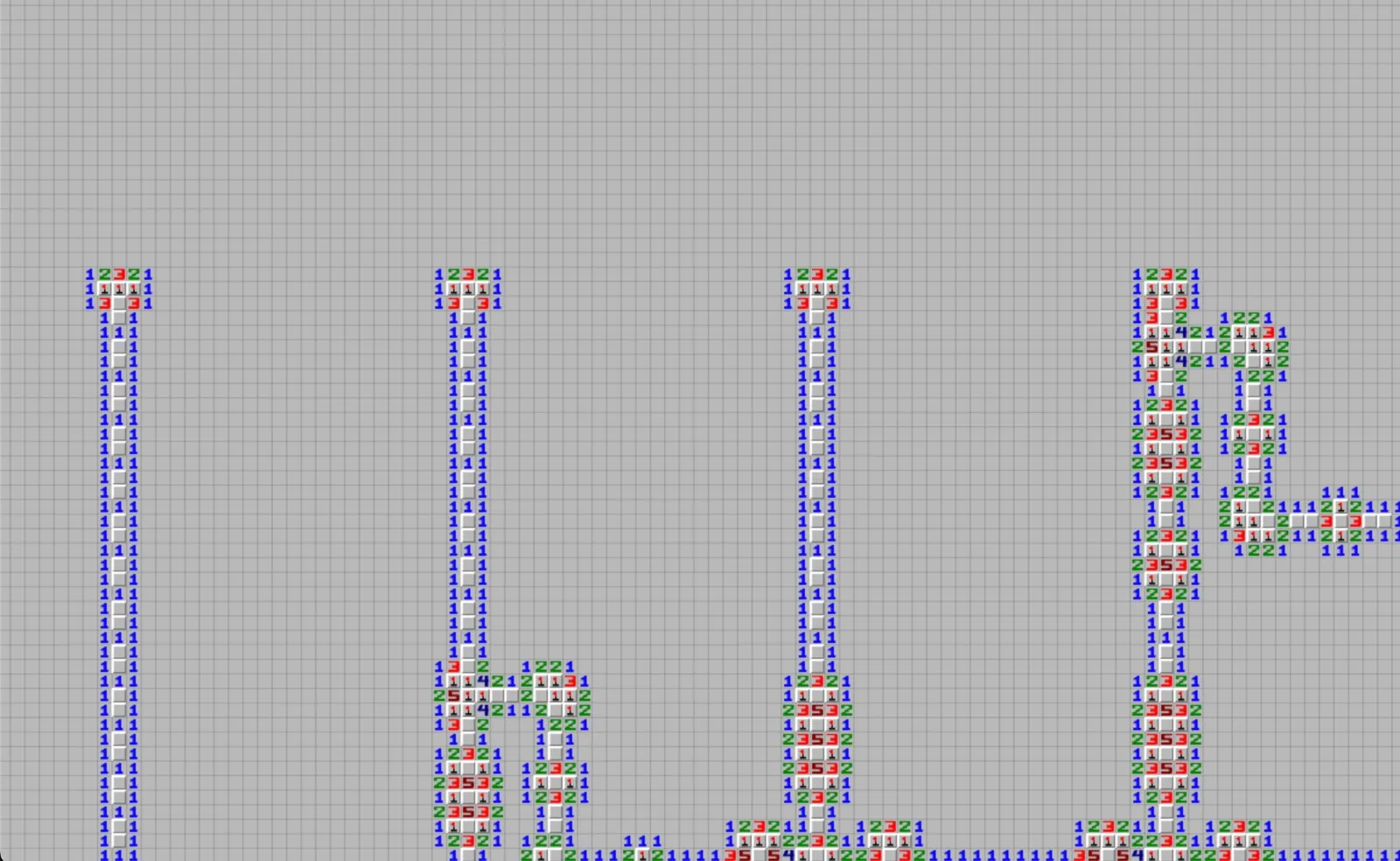
This challenge was quite fun and easy, you are given a simple python program that uses pygame to render a huge minesweeper board ( with a couple million cells )
In addition they also tried to force the board in a very peculiar case in which you couldn’t simply solve it greedily because you need some domino effect to clear the doubts about which mines to place
The two solutions I thought about where:
- Developing a custom algorithm to solve it, maybe using recursion ?
- Using a modeling approach to translate the game to a mathematical problem
Fortunately enough I immediately found this wonderful article from Robert Massaioli that teaches you how to translate a minesweeper board to a system of linear equations.
Basically you need to generate an equation for each constraining cell ( the ones with numbers ) and a variable to each closed cell.
Solving the system is then quite straightforward using z3
from tqdm import tqdmfrom z3 import Int, Solver, ArithRef, sat, simplifyimport code
grid = []with open('gameboard.txt', 'r') as fin:    circuit = fin.read()    circuit = circuit.replace(' ', '0')    for line in tqdm(circuit.split('\n')):        grid_line = []        for cell in line:            if cell == 'B':                value = -1            elif cell in "012345678":                value = int(cell)            else:                value = None            grid_line.append(value)        grid.append(grid_line)

def get_cell_name(x, y):    return f'x_{x}_{y}'
def get_cell_value(x, y, grid):    return grid[x][y]
def get_cell(x, y, grid):    return Int(get_cell_name(x, y)), get_cell_value(x, y, grid)

def get_neighbours(x, y, grid):    neighbours = []    for i in range(-1, 2):        for j in range(-1, 2):            if (i == 0) and (j == 0):                continue            if (x+i < 0) or (y+j < 0):                continue            if (x+i) >= len(grid) or y+j >= len(grid[x+i]):                continue            neighbours.append((x+i, y+j))    return neighbours
# Generate the equation systemequations = []for x in tqdm(range(len(grid))):    for y in range(len(grid[x])):
        cell_name, cell_value = get_cell(x, y, grid)        if (cell_value is not None) and (cell_value > 0):
            neighs_positions = get_neighbours(x, y, grid)
            neigh_cell_values = [get_cell_value(x_neigh, y_neigh, grid) for x_neigh, y_neigh in neighs_positions]            neigh_cell_names = [get_cell_name(x_neigh, y_neigh) for x_neigh, y_neigh in neighs_positions]
            neigh_valid_cell_names = [Int(name) for value, name in zip(neigh_cell_values, neigh_cell_names) if (value is None)]            neigh_valid_cell_values = [-value for value, name in zip(neigh_cell_values, neigh_cell_names) if (value is not None) and (value < 0)]
            equation = (cell_value == sum(neigh_valid_cell_names + neigh_valid_cell_values))
            if not isinstance(equation, bool):                for valid_cell_name in neigh_valid_cell_names:                    equations.append(equation)                    equations.append(valid_cell_name >= 0)                    equations.append(valid_cell_name <= 1)

# Solve the systemtry:    print(f"Try to solve for {hint}")    s = Solver()    for equation in tqdm(equations):        s.add(equation)

    for i in range(10):        res = s.check()        print(f"Result {i}: {res}")
        model = s.model()        print(model)        with open(f'model_{i}.txt', 'w') as fout:            for line in model:                out_line = f'{line} {model[line]}\n'                fout.write(out_line)
except KeyboardInterrupt:    code.interact(local=locals())except Exception as e:    print(e)    exit()
This will generate a simple mapping file like this
x_590_211 1x_211_2894 1x_550_211 1x_1242_680 0x_70_211 1....Now you can use the solution to overwrite the original board, open the game, press m to get the flag and the job is done !